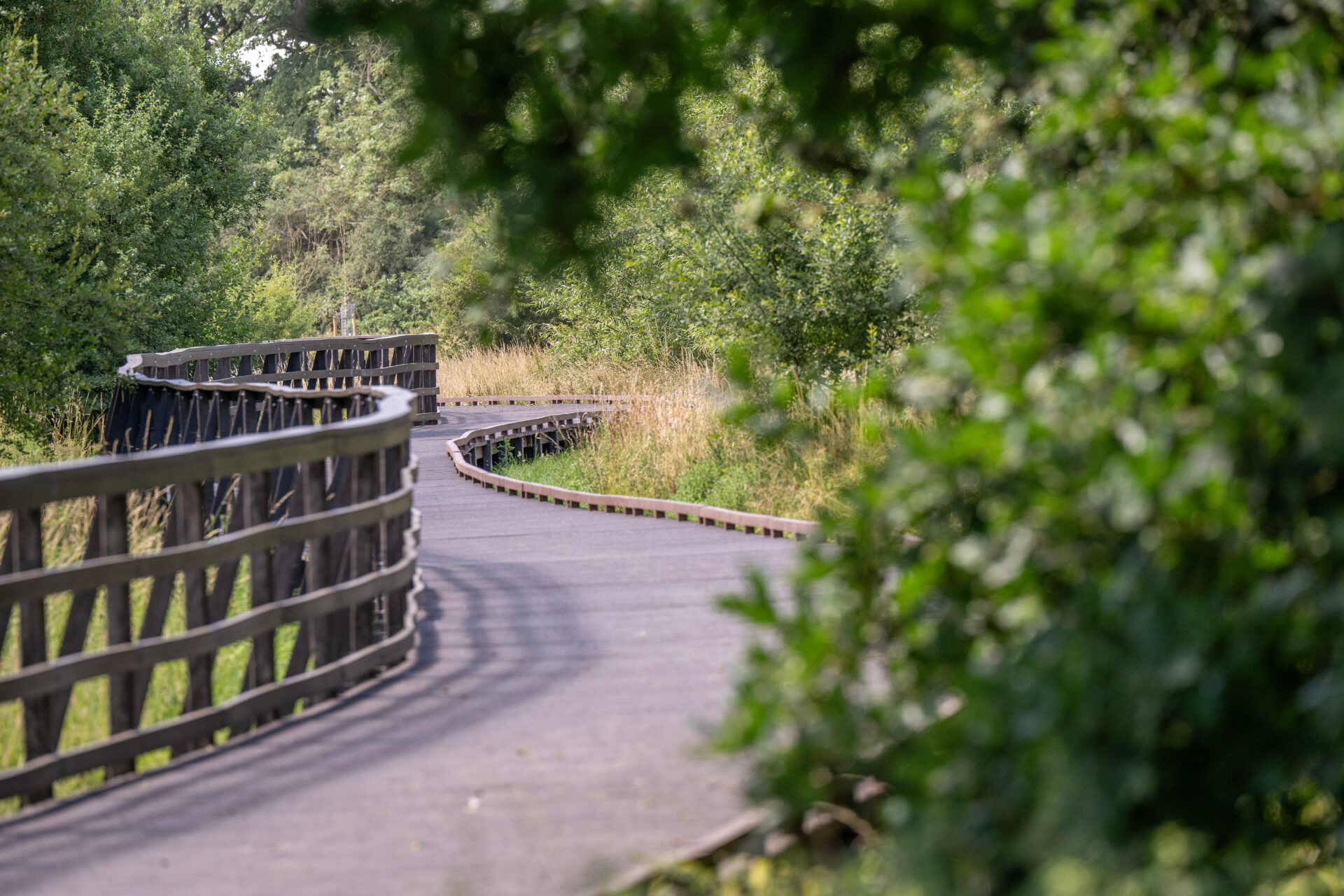
Keystone’s Habitats team were contracted by Barratt David Wilson Homes for their Wichelstowe, Swindon site to design, supply, and install a 523m-long raised recycled plastic boardwalk. This route was designed to provide connectivity between housing parcels while allowing ecologically sensitive access through the ‘Central Ponds’ wetland area.
The boardwalk forms the first phase of a longer run that will eventually follow the central ‘green spine’, forming a key segment of the Wichelstowe tracks and trails network.
It was agreed with the client that a recycled plastic structure would lend itself best to the environment, providing a low maintenance and durable pathway through ecologically sensitive areas on site.
Challenge
The boardwalk structure incorporated two bridges across a brook, a large viewing platform, and a triangular pad designed to accommodate a tree at the confluence of boardwalk routes. Several challenges were encountered and appropriately addressed during the project:
Underground Services
A medium-pressure gas main and a buried HV electrical cable cross the site along the boardwalk route. Trial pitting was carried out to confirm the presence and depth of these services. An ‘above-ground’ installation methodology was developed to raft the structure over all no-dig areas. Through coordination with the client, liaison with the utility providers meant approval for this method was achieved and delivered.
Flood Risk
The boardwalk’s proximity to a brook required careful consideration of Environment Agency (EA) flood levels. The design ensured minimal impact on floodplain capacity while remaining passable under 1:100 year flood scenarios.
Ground Conditions
The site presented challenging ground conditions at the project’s start. Careful logistical planning and the use of Keystone’s ground protection boards enabled progress to be maintained, keeping the project on schedule.
Water Vole Presence
Ecological surveys at bridge crossing locations identified water vole burrows. Licenced displacement activities were undertaken at each works location, supported by ecological enhancements downstream. Screw pile abutments were employed to minimise bankside disturbance, allowing voles to recolonise once bridge works were complete.
Approach
Keystone worked closely with the client to develop a robust and durable structure tailored to the site’s needs. The boardwalk was designed to provide a raised, flood-considerate pathway, offering a scenic route over sensitive wetland areas while protecting local ecology.
The collaborative design process ensured that:
- The boardwalk’s deck height remained above EA flood levels;
- Structural design was approved in line with site constraints;
- Materials were delivered in batches to avoid overloading the compound;
- Construction progressed systematically from the compound up through the site, allowing the newly completed sections of boardwalk to be used as access routes for materials and personnel.
Outcome
The raised recycled plastic boardwalk was successfully designed, supplied, and installed to specification, providing a durable, low-maintenance route that enhances connectivity across the Wichelstowe site.
Where required, our above-ground installation approach effectively mitigated risks related to underground utilities, ensuring compliance.
The boardwalk’s elevation respected floodplain requirements, maintaining accessibility during high water events and safeguarding the floodplain capacity.
Despite challenging site conditions, careful planning and ground protection enabled the project to stay on schedule and within budget.
Ecological considerations were met with successful displacement of water voles and minimal bankside disturbance, contributing to habitat conservation and allowing wildlife to recolonise the area post-construction.
The inclusion of bridges, viewing platforms, and features such as the tree pad enhanced the amenity value of the route for residents and visitors alike, providing excellent opportunities for community engagement with the natural environment at Wichelstowe.